
The first curriculum
Academic survival guides teach junior researchers how to live with the judgements of senior scholars. No corresponding genre gives young researchers authority to advise the people who judge them.

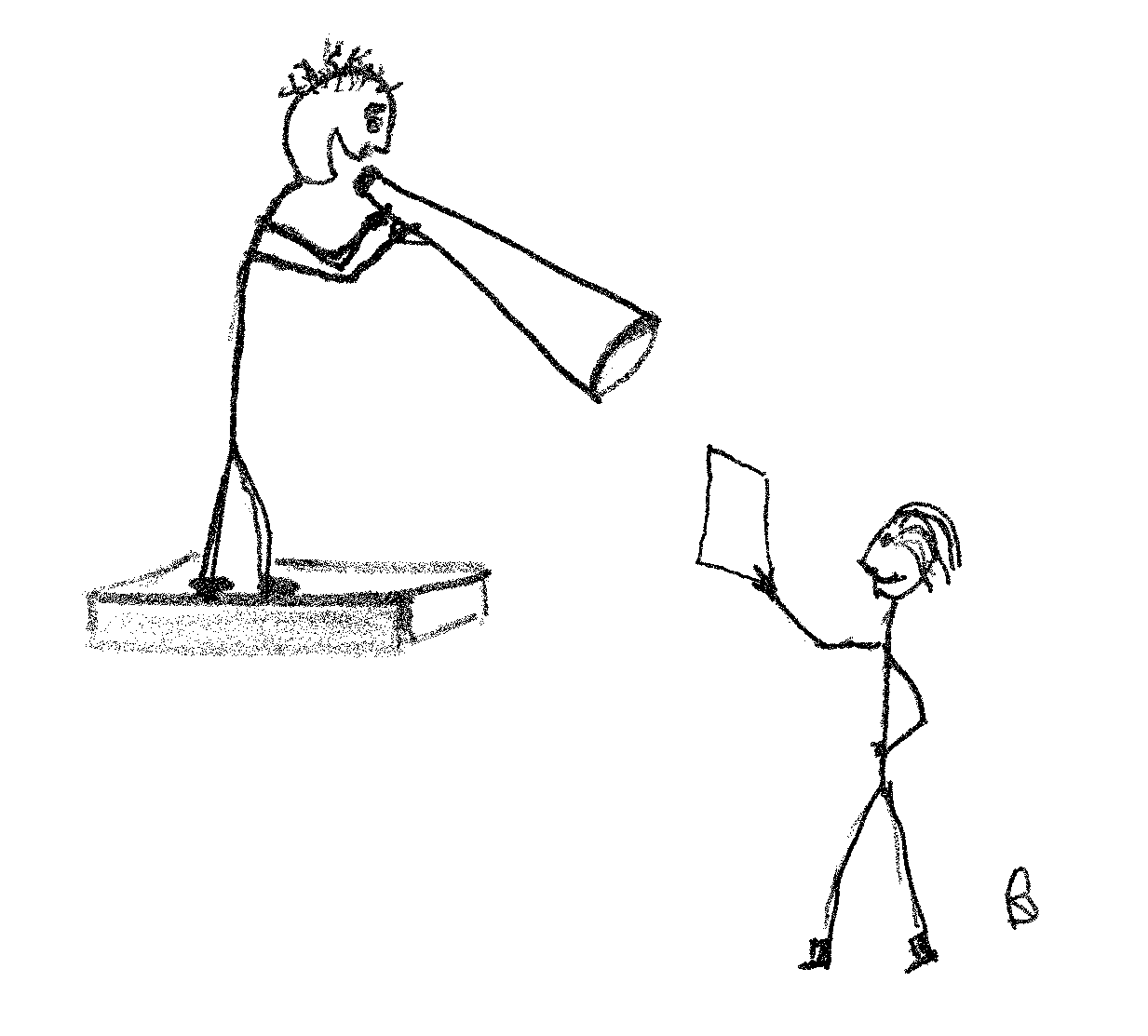
Survival as a doctoral student often begins with adopting a strategy before understanding what, exactly, needs to be survived. The strategy is usually supplied by someone who survived the system. And prospered.
Most PhD students inherit a canon before they choose one. Between acceptance and arrival, many are handed – or find online – one of the numerous guides to surviving a PhD. Personally, and being aware that anxieties can already be high, I don’t favour doing this. I’d rather incoming students found their own way within a supportive structure. But I do provide a link to a folder with papers on research ethics, on writing, on giving a seminar and on authorship. By the way, John Roth’s Giving a Seminar: Suggestions for Graduate Students is outstanding. Memorably, it starts:
Public speaking shares some features with making love. There is no absolute standard of how to do it well, but there are universally accepted ways to do it badly.
I digress. The canon runs to decades of posts, memoirs, comic strips, books and guides: Manage your adviser. Protect your time. Publish early. Recognise the signs of burnout in yourself. It is a well-meaning literature, mostly written by people trying to spare the next cohort of students the blind stumbling they remember.
It is also, almost without exception, literature written by people the system did not reject. Peter Feibelman had a career at Los Alamos before he wrote the advice contained in A PhD Is Not Enough. Richard Hamming spent decades at Bell Labs. Robert Peters, Hugh Kearns & Maria Gardiner, Ronald Azuma, Steven Weinberg – every name attached to a widely read survival guide – is a name the system kept. Even Karen Kelsky, who established a business on telling people to leave academia, built it from the position of someone who’d achieved tenure first. Radhika Nagpal‘s Awesomest 7-Year Postdoc, one of the best-known essays in the genre was written by a Harvard faculty member reflecting on her pre-tenure years. These are survivors describing the course to people still running it. Their authority to explain the system was conferred by the system itself.
This shapes what the advice can say. Matt Might’s list of reasons that students fail runs through perfectionism, procrastination, chasing grades and poor time management. He frames attrition as a set of correctable habits. Nagpal names the cause directly: a system “that admires and rewards extreme imbalance.” After that diagnosis, the essay returns to what a person can do anyway: quotas, fixed hours, a folder of good news for bad days.
The inverse literature has never acquired a canon. There is no widely read essay called “What early-career researchers wish hiring committees understood“, written with the same commanding voice those referred to above use. And no postdoc-authored guide telling a search committee how to weigh a CV, or a tenure committee how to read a narrative statement, or a grant-review panel how to stop defaulting to journal prestige when a decision gets hard, or a PI how to assign authorship when the hierarchy of the lab is already doing the deciding. Postdocs have plenty of material. They are the ones in the room, well, maybe just outside it, watching committees reach for the easiest number when a judgement call gets difficult. They know precisely what they would tell a hiring committee to do differently. A postdoc’s account of committee practice is usually filed under complaint, advocacy or testimony. Academic rank turns the same account into advice. A junior researcher instructing a professor on how to run a committee isn’t a genre. A professor instructing a junior researcher on how to survive one is the whole genre.
Even systemic critiques preserve the hierarchy of address. Nature’s 2019 editorial on PhD mental health called for “systemic change to research cultures” and assigned responsibility to funders, institutions, journals and publishers. Alberts and co-authors went further, recommending higher postdoc pay, limits on postdoctoral funding, more staff-scientist positions and changes to grant review. The structure remained familiar: academic authority converted the conditions of early-career researchers into recommendations for other authorities. The people living under those conditions still had no standing to instruct the people governing them.
Jessica McCrory Calarco‘s term for something adjacent to this is the “hidden curriculum”: the unwritten rules of doctoral training, transmitted unevenly, that quietly sort students by how much they already knew before they arrived. The advice genre carries an earlier lesson than the hidden curriculum: where blame lives, who may assign it, and which direction instruction is permitted to travel. Long before a student can evaluate a funding model, they’ve absorbed that instructing the people above you is not a thing people in your position do. By the time they could plausibly write that essay, they’ve had a decade of practice not writing it.
Upward advice requires a channel with consequences attached. Three possibilities:
1. A hiring committee could be required to set its criteria down before opening a single application, then explain its choice against those criteria. Unsuccessful candidates could read that account and contest departures from the stated process.
2. A department could give its postdoc and PhD representatives an actual vote on the hiring and promotion committees whose decisions will shape their careers, rather than a seat with a view of the room.
3. A lab’s own trainees could be asked, as a formal part of that lab’s periodic review, how their supervisor performed as mentor and judge.
Each proposal adds a procedure, attaching consequence to observations currently easy to ignore. A postdoc’s account of how a committee behaved would carry institutional weight alongside a professor’s judgement of the postdoc. A vote counts for something a suggestion box never does, and that difference is the mechanism this literature has spent decades failing to build.
Whatever the right instruments, decades of advisory literature have taught people how to survive the system while leaving the system largely unanswerable to them. That’s the sentence the genre keeps almost writing, and never finishes.