
The one-way audit
Researchers are required to account for their time and money. Administrative procedures rarely include any account of the research time they consume.

In the last post, The first curriculum, I wrote about a disparity in academic life. Advice about academic careers tends to flow from people who are senior, and who have survived the system, to people just entering it. Those at the receiving end have no corresponding voice with which to tell their seniors what they should be doing.
Today’s post also concerns things flowing downhill. Well, perhaps sideways. Occasionally they seem to come from nowhere.
Forms, declarations, approvals, reporting systems, mandatory modules. Unnecessary bureaucracy. And the systems that impose it.
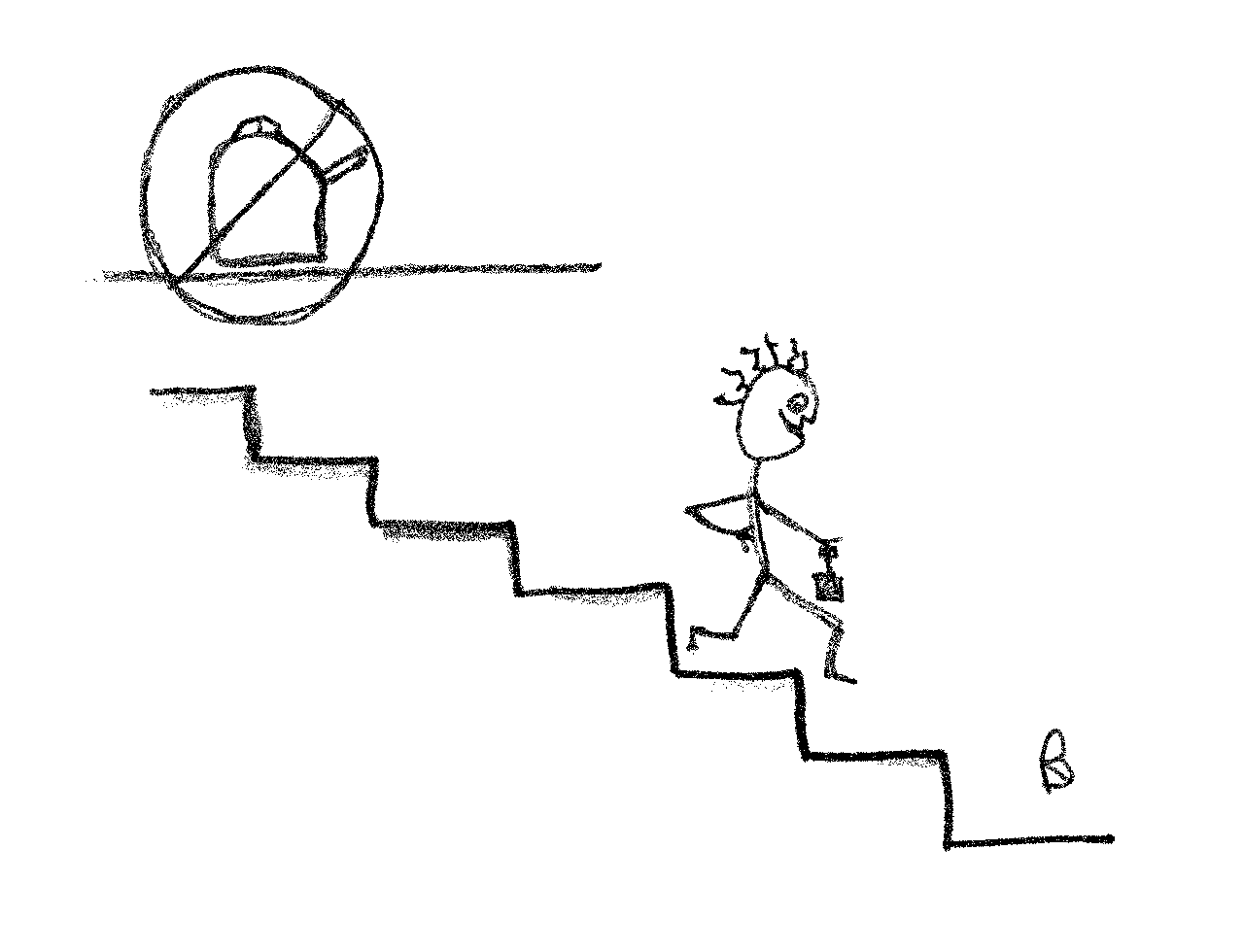
I am not supposed to boil a kettle in my office because the electricity would come from public funds. If I want tea, in principle, I should take my own teabag, walk down two flights of stairs and along to the cafeteria, pay money into a machine – purchased from public funds, but whose cost stands to be offset by private payment – to obtain boiling water.
Before I travel and when I return there are a barrage of forms. I could fill the post with examples of this kind, I could elaborate the stupidity until I exploded, just as I am sure, all you reading could. Fortunately I have an exceptional PA who shields me from much of the daily bureaucracy, a luxury many academics do not have. While I could rant until the cows descend the furthermost hill, I will try turn OFF the rant-switch.
But before fully disengaging, what about microbial safety levels, regulations for genetic manipulation? This has all gotten so absurdly chaotic that what is important is lost within a morass of utter confusion. Ok, rant-switch OFF, but the time and energy consumed – the stress caused – beggars belief.
In a paper I recently co-authored, led by Ken Timmis with fourteen colleagues in a dozen countries, we set out to diagnose the problem and propose a remedy. It appears in Microbial Biotechnology as part of the Scientists’ Warning to Humanity series, which more usually concerns itself with topics including climate, biodiversity loss and antimicrobial resistance. Bureaucracy sits oddly in this company until you consider what it does to the people working on these topics.
The argument turns on a piece of ordinary economics. When a factory discharges waste into a river, the cost of cleaning the river appears in nobody’s accounts. The firm’s books look healthy. Someone still pays: the taxpayer, the fishery downstream, the child with asthma. Economists call this externalisation. The principle that producers should carry their own costs is written into environmental law across most of the world, and enforcement is loose enough that the externalised costs of the global food industry are still estimated at twelve trillion dollars a year. That is the state of the art in a domain where the principle has statutory force. In administration it has never been named.
Administrative work externalises costs in exactly this fashion, and it is rarely counted.
When a form is badly designed, the work of designing it well lands somewhere else, as forty minutes of a postdoc’s afternoon, multiplied by everyone required to complete it. When an online system is deployed without adequate testing, its missing quality control reaches the user as dead ends, repeated logins, password changes, and calls to a helpdesk. When a task an administration could perform is delegated instead to the people it serves, the work moves to a place where nobody measures it.
Ever tried submitting a paper with 20-plus authors to a scientific journal, all from different institutions? Dealt with the fact the system won’t progress until the abstract is 120 words or less, every author’s email, institution, address (including city and country), title and ORCID number is provided? Combine this with the fact that only a small fraction of authors exist in the journal’s database. The hours taken – let alone the frustration – are sufficient to have written another paper, shot a deer, cooked a banquet and travelled to NZ without need to seek counselling.
Hence the asymmetry. The institute is audited, and rightly so, since it spends public money. That audit propagates downwards. Before I travel I state where I am going, why, on whose budget, by what means, at whose invitation. The travel is then arranged and the crap that this involves is spectacularly smelly. On return I account for it again. Every euro is traceable and I would defend the principle. The procedures themselves face no comparable examination. Nobody records what a new reporting requirement costs in research hours across a department, whether the benefit exceeds that cost, or even whether the resulting file is ever opened. The audit runs in one direction.
A colleague took a taxi from the airport to their institute and claimed the fare, citing heavy bags. The auditors, who held the flight booking, observed that the ticket did not include checked luggage. The colleague was required to pay for the taxi. Set aside whether the excuse was sound. The fare was fifty euros. Nobody has costed the hours spent cross-referencing a receipt against a ticket class, nor the correspondence that followed, nor the time the colleague spent replying to it. The fifty euros recovered appears in an account somewhere. The cost of recovering it appears nowhere.
Making it run in both is most of what Timmis et al propose. Every bureaucratic measure, existing or new, should pass three assessments. Does it externalise costs onto the people it governs? Does it observe a duty of care towards them? What are its consequences for their health? Alongside these sits a very basic question: what would be the consequence of not having this? Applied honestly, it disposes of a great many mandatory fields, obligatory declarations and requests for personal data that survive because someone once thought the information might conceivably prove useful.
Incidentally, the kettle rule passes that test. The electricity is public money, the tea is mine, and someone can state the reason in a single sentence. Most of what reaches our desks has never been through the same exercise.
The machinery to effect change is modest, and any institute could assemble it within a year. A Bureaucracy Oversight Task Force drawn from the workforce, the leadership and the administration, chaired by an elected member of the workforce. A standing survey asking people which measures waste the most of their time. An ombudsperson to receive complaints in confidence, since anyone who depends on an office for a contract extension has good reason to keep quiet. A published report, at intervals, of what was raised and what changed. I know what most committees achieve. This one differs in a single respect, which is who chairs it.
Administrations exist to exercise oversight, and someone has to oversee them. The people best placed to identify a worthless procedure are the ones obliged to complete it, and they are usually the last to be asked. Which returns me to where the last post ended, at the disparity between those who speak and those who are spoken to.
Ideas keep their own hours. They arrive in the shower, on a run, halfway through a conversation over coffee, during an afternoon with nothing scheduled in it. The conditions that preserve such time might be thought of as imagination infrastructure: it deserves the seriousness we extend to buildings and IT. Administrative load erodes it twice over: once in the hours consumed, and again in the residue of irritation an hour with a broken web form leaves behind, which occupies the mind for a good while afterwards and crowds out everything else.
The World Health Organisation attributes twelve billion lost working days a year to depression and anxiety, at a cost of a trillion dollars. A 2025 EU survey found close to thirty per cent of workers reporting stress, anxiety or depression caused or worsened by work. Two in five UK teachers work the equivalent of twenty-six unpaid hours a week; one study found physicians spending twice as long on paperwork as with patients. There are ninety-four million teachers and sixty-five million health workers in the world. Antimicrobial resistance is projected to kill ten million people a year by 2050 – the equivalent of a fully loaded 787 going down every fifteen minutes – and the therapies that might slow it are being developed by researchers who spend significant time on compliance and form filling. Delay in this kind of work has a cost measured in illness and death, and it doesn’t appear on any ledger.
A disclaimer, which the Timmis et al paper carries formally and which I want to repeat here. We write at a moment when the language of cutting red tape is being used, in several countries, to dismantle the checks that restrain governments and firms from doing harm. Our argument rests on the instruments those checks embody: accountability, transparency, consultation of stakeholders, oversight of the overseers, a duty of care towards the people affected. Good administration exists to empower them. We ask that they be applied, for once, to administration itself.
Ask it of the next administrative requirement that lands on your desk. What would be the consequence of not having this land?
Timmis, K., Karahan, Z.C., Byrne, J.A., Robinson, J.M., Bernal, P., Rainey, P.B., López-García, P., McGenity, T.J., Chavarría, M., Sato, K., Verstraete, W., Blank, L.M., Lal, R., Colom, M.F. and Ramos, J.L. (2026) Scientists’ Warning to humanity: unnecessary bureaucracy is a global impediment to productivity, advancement of human and planetary wellbeing, science and sustainability. Microbial Biotechnology 19: e70371. Open access: https://doi.org/10.1111/1751-7915.70371